
The Journal / Breast Augmentation
Natural Looking Breast Implants: The Art of the “Undetectable” Breast Augmentation
The best breast augmentation does not necessarily look like a breast augmentation.
Implant width, profile, placement and tissue preservation — how Dr. John Burns in Dallas plans results that keep them guessing.

Medically reviewed by John L. Burns Jr., MD, FACS · Board-certified plastic surgeon · Dallas, Texas · Updated October 2026
Recognized by


The short answer
Natural looking breast implants come from proportion, not just small volume: an implant whose width fits your breast base, a profile that complements your frame, enough soft-tissue coverage, a precise pocket, and — for the right patient — above-muscle placement that moves with the breast and avoids animation deformity.
Want to know which approach fits your anatomy? Start a free online breast augmentation consult and share your goals with Dr. Burns’ team.
More and more patients are asking for what might be called an “undetectable” implant result—breasts that look naturally full, proportional, soft, and believable enough that other people are left wondering whether they are natural.
At the practice of John Burns, MD, FACS, this is one of the central goals of modern breast augmentation: keep them guessing.
An undetectable result does not mean choosing the smallest implant possible. Conservative sizing can certainly help, but natural breast augmentation depends on much more than implant volume. Implant dimensions, profile, placement, tissue preservation, soft-tissue coverage, pocket control, and how the implant behaves when the patient moves are all critical.
The goal is not simply to make the breasts bigger.
The goal is to make them look like they were always meant to be that way.
What Does “Undetectable” Really Mean?
An undetectable breast augmentation should not immediately announce itself.
Ideally, the result should have:
- a natural upper-pole slope
- proportional cleavage
- soft transitions between the breast and chest wall
- appropriate movement
- good symmetry
- no obvious implant edges
- no excessive roundness
- no animation deformity
- a size that fits the patient’s frame
The breast should look attractive in clothing, swimwear, exercise wear, and without clothing.
Perhaps most importantly, it should look like the patient’s breast—not an implant sitting inside the breast.
Who Is a Good Candidate for Natural Looking Breast Implants?
The American Society of Plastic Surgeons describes good candidates as healthy, non-smoking adults with realistic expectations. A natural-result plan tends to suit patients who:
- want fuller breasts that match their frame
- are athletic and want to avoid implant movement when they flex
- have enough tissue to cover an implant, or are open to fat grafting
- have sagging that needs a lift, in which case a breast lift with implant may be part of the plan
Thinking about the investment? Explore breast augmentation financing options (CareCredit, PatientFi and Cherry), then request your consultation.
Natural Does Not Always Mean Small
One of the biggest misconceptions is that natural breast augmentation always requires a very small implant.
That is not necessarily true.
A conservative implant size often makes a natural result easier to achieve because it places less stress on the breast envelope and is less likely to overwhelm the patient’s anatomy. But a larger implant can still look natural if it is appropriately matched to the patient’s chest width, breast dimensions, tissue thickness, and overall body proportions.
The key is proportion.
A 300 cc implant may look subtle on one patient and very prominent on another.
That is why implant selection should never be based on volume alone. (For more on how volume relates to cup size, see breast implant sizes explained.)
Implant Width Matters as Much as Implant Volume
One of the most important principles in natural breast augmentation is matching the implant to the patient’s breast base width.
If an implant is too wide, it may extend beyond the natural breast footprint, create excessive lateral fullness, or make the breast appear artificial.
If it is too narrow and overly projected, it can create a conspicuous “ball on the chest” appearance.
The most natural implant usually fits comfortably within the native breast boundaries and complements the patient’s existing anatomy.
This is one reason 3D planning can be so valuable.
At Dr. Burns’ practice, Crisalix 3D imaging can help patients compare different implant widths, profiles, and volumes before surgery so the final choice is based on the entire shape—not simply a cup-size goal.
Profile Is Critical
Two implants can have the same volume and look completely different.
A lower-profile or moderate-profile implant tends to distribute volume across a wider base and may create a softer transition through the upper pole.
A higher-profile implant places more volume forward and can create greater projection.
Neither is automatically better.
The correct profile depends on:
- chest width
- existing breast tissue
- desired projection
- body proportions
- skin elasticity
- overall aesthetic goal
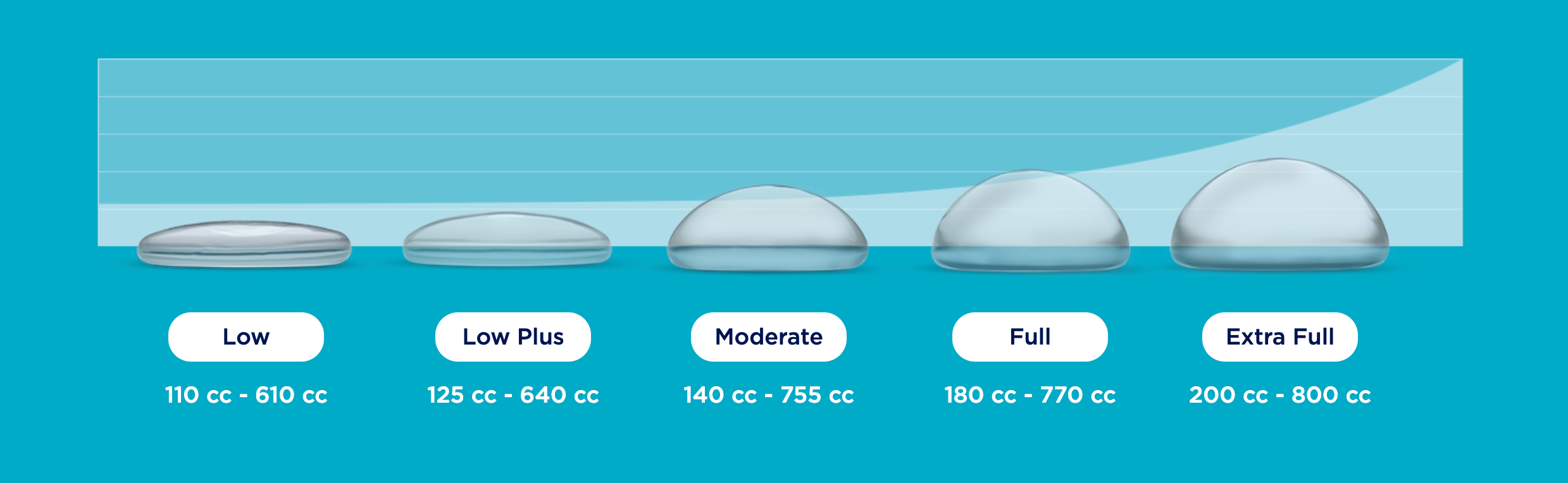
For an undetectable result, profile selection should complement the patient rather than exaggerate the implant.
Preservation Breast Augmentation and the Natural Breast
Technique is just as important as implant selection.
PRESERVE breast augmentation is built around the concept of maintaining the patient’s native breast anatomy rather than unnecessarily disrupting it.
Instead of extensively cutting tissue to create a pocket, PRESERVE is designed to minimize tissue disruption and preserve the natural internal support structures of the breast.
This can help maintain the relationship between the implant and the patient’s existing breast tissue.
The result is not simply an implant placed under the skin.
It is an implant that is integrated into the patient’s native breast envelope.
For patients seeking an undetectable augmentation, that concept is particularly appealing.

Why Above-the-Muscle Placement Can Look More Natural
Many patients assume that placing a breast implant under the pectoralis muscle is always more natural.
That is not necessarily the case.
In appropriately selected patients with adequate soft-tissue coverage, an above-the-muscle or subfascial implant can behave much more like a natural breast.
The implant and breast move together as one unit.
This is especially important during exercise and chest muscle contraction.
With a submuscular implant, contraction of the pectoralis muscle can compress and move the implant, producing animation deformity. The breast may flatten, shift upward, or distort when the patient flexes.
For athletic patients, this can make the implant much more obvious.
An above-muscle implant avoids this problem because the pectoralis muscle is not draped over the implant.
The breast moves naturally while the chest muscle functions underneath it.
That can be a major advantage when the goal is to “keep them guessing.”

Above-muscle vs. under-muscle placement at a glance
General comparison for education; the right plane is chosen for each patient at consultation.
Avoiding Animation Deformity
Animation deformity is one of the clearest giveaways that someone has breast implants.
It can become particularly noticeable during:
- weightlifting
- push-ups
- yoga
- Pilates
- swimming
- chest exercises
- everyday arm movements
For highly active patients, avoiding animation can be just as important as avoiding visible implant edges.
This is why PRESERVE and other carefully selected prepectoral techniques are especially appealing for athletes.
A breast that moves naturally is much harder to identify as augmented.
Research has looked at this directly: a randomized controlled trial in breast reconstruction evaluated animation deformity after prepectoral versus subpectoral implant placement.

Soft-Tissue Coverage Still Matters
Above-the-muscle placement is not ideal for every patient.
If a patient is extremely thin and has minimal breast tissue, the implant may be more visible or palpable.
This is where surgical judgment becomes critical.
Options to improve camouflage may include:
- choosing a smaller implant
- selecting a softer or more anatomically behaving implant
- using a subfascial plane
- adding fat grafting
- avoiding excessive implant projection
- carefully controlling the pocket
The goal is to create enough soft-tissue coverage that the implant edge disappears into the surrounding breast.
Wondering whether above-the-muscle placement is right for you?
Dr. Burns will assess your tissue coverage, chest width and activity level to recommend a plan built for natural movement.
Start your free online consultFat Grafting Can Make Implants Even Less Detectable
Hybrid breast augmentation combines an implant with fat grafting.
This can be extremely useful for natural results.
Small amounts of fat can be strategically placed along:
- the upper pole
- the medial breast
- the cleavage zone
- visible implant edges
- areas of asymmetry
The fat acts like a soft-tissue camouflage layer.
It can smooth transitions and make the implant less visible, especially in thin patients. (The fat is harvested with gentle liposuction from an area such as the abdomen or flanks.)
Instead of relying on a larger implant to create every part of the breast shape, the implant provides the basic structure while fat fine-tunes the contour.
This can produce an exceptionally natural result.
The Inframammary Fold Must Look Natural
A beautiful breast augmentation depends heavily on the inframammary fold, or breast crease.
If the fold is too low, too high, asymmetric, or poorly controlled, the result can look artificial.
The fold should support the implant and maintain the correct relationship between the breast and chest wall.
Preserving or carefully controlling the fold helps avoid:
- bottoming out
- double bubble deformity
- excessive lower-pole stretch
- implant malposition
Natural breast augmentation requires precise pocket construction, not simply placing an implant and hoping the tissues adapt.
Avoiding the “Too Round” Look
One of the classic signs of an obvious breast augmentation is excessive upper-pole roundness.
A natural breast usually has a gentle slope from the upper chest into the breast mound.
That does not mean the upper pole should be empty.
It means fullness should transition smoothly.
Several factors influence this:
- implant profile
- implant gel characteristics
- implant position
- tissue thickness
- implant size
- skin elasticity

For patients who want the most natural aesthetic, the goal is generally a soft upper-pole transition rather than a hard, spherical contour.
Motiva and Natural Breast Movement
Modern implant technology also plays an important role.
Motiva implants are especially well suited to patients seeking a natural result because of their soft gel characteristics and implant options designed to behave dynamically with the breast.
The Ergonomix concept, for example, is intended to create a softer, more natural shape that changes with body position.
When combined with a tissue-preserving, above-muscle technique, the implant can behave more like part of the breast rather than a fixed object inside it.
This is exactly the type of result many patients mean when they say:
“I want them to look natural.”

Smaller Incisions Help Maintain the Illusion
Even a beautiful breast can reveal surgery if the scar is obvious.
Incision placement therefore matters.
Common options include:
- inframammary crease
- transaxillary
- selected periareolar approaches
With PRESERVE, selected patients may be candidates for a small inframammary or transaxillary access point.
Careful scar placement and postoperative scar management can help make the evidence of surgery less noticeable.
The goal is not only an undetectable implant—but an undetectable operation.
Preserve Nipple Sensation and Breast Function
A natural result should not only look natural.
It should ideally feel and function naturally as well.
Minimizing unnecessary tissue disruption may help preserve:
- nipple sensation
- breast sensation
- breastfeeding potential
- native tissue movement
This is especially important for younger patients who may undergo augmentation before pregnancy or breastfeeding.
The most sophisticated breast augmentation is not simply about appearance.
It is about preserving normal anatomy whenever possible.
Keep the Pocket Precise
A pocket that is too large is one of the easiest ways to create an unnatural result.
Excessive pocket dissection can allow the implant to drift:
- laterally
- inferiorly
- medially
This can create:
- bottoming out
- lateral displacement
- loss of cleavage control
- asymmetry
- symmastia
A precise pocket helps hold the implant exactly where it belongs.
The implant should fit the pocket—not float inside it.
This is another reason tissue-preserving techniques are so attractive: less unnecessary dissection may mean more native support remains intact.
Internal Support When Needed
Some patients naturally have weaker tissues.
In these cases, additional support may be beneficial.
An internal mesh bra can be used selectively to reinforce the lower pole and help stabilize the implant.
This can be particularly useful in:
- revision surgery
- augmentation mastopexy
- patients with thin tissues
- patients prone to bottoming out
- larger implant cases
The most natural result is not always created by doing less.
Sometimes it requires adding support in exactly the right place.
The Best Breast Augmentation Fits the Whole Body
A natural breast cannot be evaluated in isolation.
The implant should fit the patient’s:
- shoulders
- rib cage
- waist
- hips
- height
- overall build
A petite athletic patient may need something very different from a taller patient with a wider chest and broader hips.
The best result creates harmony between the breasts and the rest of the body.
This is why copying someone else’s implant size rarely works.
Natural augmentation must be individualized.
Natural Breast Augmentation Results
Every patient’s anatomy is different, so the most useful way to judge a natural looking breast augmentation is to look at real patients with a frame similar to yours. Browse Dr. Burns’ before-and-after photo gallery and read patient reviews to see how results look across a range of body types. Individual results vary.
Recovery Timeline After Breast Augmentation
These are general estimates; Dr. Burns gives you a personal plan.
Tightness and soreness; rest, short walks and a support bra.
Many patients return to desk work and light daily activity.
Gradual return to exercise once cleared.
Swelling settles, the breast softens and scars fade.
Above-muscle and awake breast augmentation approaches avoid cutting the chest muscle, which may make early recovery more comfortable.
Risks and Safety Considerations
All breast surgery carries risk. The U.S. Food and Drug Administration lists complications that include capsular contracture, rupture, infection, hematoma, seroma, implant malposition and the need for additional surgery, along with rare risks such as breast implant–associated anaplastic large cell lymphoma (BIA-ALCL) and systemic symptoms some patients describe as breast implant illness. The FDA also notes that breast implants are not considered lifetime devices.
Natural-result techniques aim to reduce problems such as visible edges, animation, bottoming out and symmastia, but no technique eliminates risk.
What Does Natural Breast Augmentation Cost in Dallas?
Cost depends on the implant type, whether fat grafting, a lift or internal support is added, anesthesia and facility fees. For a full breakdown, read our guide to breast augmentation cost in Dallas; your personal quote is provided at consultation.
Monthly payment plans are available through our financing partners. When you are ready, schedule your natural breast augmentation consultation.
Choosing Natural Breast Augmentation in Dallas
Patients come to Dr. Burns’ office on North Central Expressway from across Dallas–Fort Worth and out of state. Consultations can begin online, Crisalix 3D imaging helps you compare options before surgery, and the practice’s Dallas breast augmentation program includes Preserve, hybrid and Motiva-based approaches.
“Keep Them Guessing”
For many modern breast augmentation patients, the ultimate compliment is not:
“Your implants look great.”
It is:
“Did you have something done? You look amazing.”
That is the essence of the “keep them guessing” philosophy.
A truly successful breast augmentation should blend into the patient’s body so naturally that the surgery becomes difficult to detect.
This comes from the combination of:
- appropriate implant size
- correct implant width
- thoughtful profile selection
- preserved anatomy
- precise pocket control
- adequate tissue coverage
- above-muscle movement when appropriate
- avoidance of animation deformity
- fat grafting when needed
- careful fold control
- discreet scar placement
Natural Breast Augmentation at Dr. John Burns
Dr. John Burns specializes in breast augmentation techniques designed around precision, preservation, and proportion.
For many patients, this includes PRESERVE awake breast augmentation, subfascial or above-muscle placement, Motiva implants, 3D planning, and hybrid fat grafting.
The objective is not simply to make the breasts larger.
It is to create breasts that look beautiful, move naturally, feel proportional, and remain difficult to distinguish from a naturally fuller breast.
The best breast augmentation should not look like surgery.
It should look like you.
Natural enough to keep them guessing.
Why patients choose Dr. John Burns for natural looking breast implants in Dallas

Dr. Burns brings more than 25 years of experience in aesthetic plastic surgery to breast augmentation and was named D Magazine’s “The Face of Breast Augmentation” in 2024 and 2025 — experience that shapes how he matches implant width, profile and plane to each patient for a result that looks like her own.
Meet Dr. Burns- Board-certified by the American Board of Plastic Surgery; Fellow of the American College of Surgeons (FACS)
- More than 25 years of experience in aesthetic plastic surgery
- First plastic surgeon in the U.S. to complete a fellowship in laser surgery, at UT Southwestern Medical Center, where he is a Clinical Instructor of Plastic Surgery
- Plastic surgery residency at the University of Texas Medical Branch (summa cum laude, Research Honors Program; Alpha Omega Alpha); microvascular training at MD Anderson Cancer Center
- Graduate of Vanderbilt University; cosmetic surgery training in Miami, Florida
- Named one of America’s Best Plastic Surgeons by Newsweek (2022, 2023, 2024, 2025, 2026); 2024 categories: facelift, rhinoplasty, breast augmentation
- D Magazine Best Doctors (2023, 2024, 2025, 2026) and D Magazine’s “The Face of Breast Augmentation” (2024, 2025)
- Texas Monthly Super Doctors (2024)
- Medical Director of JOLA Aesthetics, an Allergan Double Black Diamond practice ranked among the top 20 in the U.S.
- Past President of the Dallas Plastic Surgery Institute
- Board of Directors and contributing surgeon, Share-A-Smile Foundation
Frequently Asked Questions About Natural Looking Breast Implants
What are the most natural looking breast implants?
There is no single best implant. The most natural looking breast implants have a width that fits your breast base and a profile that suits your frame; soft, dynamic gels such as Motiva’s can help the implant move like part of the breast.
Can breast implants be undetectable?
In the right patient, a result can be hard for others to detect. It depends on proportion, soft-tissue coverage, a precise pocket, natural movement and discreet scars. No surgeon can promise invisibility.
Do breast implants look more natural over or under the muscle?
Under the muscle is not automatically more natural. With adequate tissue coverage, above-the-muscle or subfascial implants move with the breast and avoid animation deformity; very thin patients may need another plane or fat grafting.
What is animation deformity?
It happens when the chest muscle contracts over a submuscular implant, so the breast flattens, shifts upward or distorts — most noticeable during weightlifting, push-ups, yoga and Pilates.
Will a larger implant always look fake?
No. A larger implant can still look natural when it matches your chest width, breast dimensions, tissue thickness and proportions. A 300 cc implant can look subtle on one patient and prominent on another.
What is subfascial breast augmentation?
The implant sits above the chest muscle but beneath the thin fascia covering it — an option that can add camouflage while keeping the natural movement of above-muscle placement.
Can fat grafting make implants look more natural?
It can. In hybrid breast augmentation, small amounts of your own fat are placed along the upper pole, cleavage or visible implant edges as a soft camouflage layer.
Can I breastfeed after breast augmentation?
Many women can, but it is never guaranteed. Minimizing tissue disruption may help preserve breastfeeding potential and nipple sensation.
How long do breast implants last?
The FDA states breast implants are not lifetime devices, and complication risk rises over time. Regular follow-up helps you and your surgeon monitor them.
The Takeaway
Natural looking breast implants are the result of planning, not luck. Matching implant width and profile to your anatomy, keeping the pocket precise and preserving native tissue are what keep people guessing. When appropriate, above-muscle placement lets the implant move with you. The right plan is individual and starts with a consultation.
Dallas Plastic Surgery Institute
Visit us for natural breast augmentation in Dallas
Meet Dr. Burns, see 3D previews of your options and leave with a plan built around your anatomy.
John L. Burns Jr., MD, FACS · 9201 N. Central Expressway, Suite 350, Dallas, TX 75231
214-515-0002 · Mon–Fri 9 AM–5 PM
Follow Dr. Burns
Continue reading
Explore the full Dallas breast augmentation guide from Dr. John Burns.
Sources: FDA — Risks and Complications of Breast Implants; ASPS — Breast Augmentation Risks and Safety; Evaluation of Breast Animation Deformity following Pre- and Subpectoral Direct-to-Implant Breast Reconstruction (PMC). This article is for education and is not medical advice. Individual results vary.