
Correction of Symmastia After Breast Augmentation
How advanced breast revision surgery restores natural cleavage, implant position, and long-term support.
Schedule a ConsultationUNDERSTANDING THE CONDITION
What Is Symmastia?
Symmastia—sometimes called "uniboob"—is a breast implant complication in which the implants migrate medially, crossing the midline of the chest and erasing the natural cleavage. Rather than sitting within their intended pockets, the implants drift toward one another, creating the appearance of a single, conjoined breast. Understanding the anatomy is the first step: when the implant pockets merge across the sternum, the soft tissue bridge that normally separates the breasts is lost, and the implants rest too close together.
Why It Happens
Symmastia can develop for several reasons, often in combination. Implant size and width play a significant role—an implant that is too wide for the chest can stretch the tissue across the midline. Capsular contracture, in which the scar tissue around an implant tightens and distorts its position, may also pull the implant medially. Weak or thin soft tissue, particularly in the central chest, offers less resistance to medial migration. And surgical technique matters: if the implant pockets are created too close together or the tissue is over-dissected, the implants have room to drift. Understanding these causes is essential to planning an effective symmastia correction.
The Emotional Impact
The physical changes of symmastia are often accompanied by a quieter, deeper toll. Many women describe a loss of confidence, a sense that their body no longer reflects the outcome they worked toward, and a reluctance to wear the clothing they once loved. These feelings are valid—and they are common. A thoughtful approach to uniboob correction acknowledges both the technical challenge and the emotional weight behind it. The goal of revision breast surgery Dallas patients trust is not simply to reposition an implant, but to restore a sense of ease and self-assurance.
For those exploring breast implant malposition and its solutions, the path forward begins with a thorough evaluation. Implant pocket repair, internal mesh support, and implant revision are among the advanced techniques that can restore natural cleavage and long-term support. If you are considering symmastia repair, a consultation with an experienced revision surgeon can help you understand your options and what to expect.
Schedule a ConsultationHow Is Symmastia Diagnosed?
01
A detailed physical examination
Symmastia is usually diagnosed through a detailed physical examination.
During a breast revision consultation, Dr. Burns evaluates the relationship between the implants, nipple position, inframammary folds, breast tissue, chest wall, and sternum.
02
Important considerations
Important considerations include:
Distance between the breasts
Whether one or both implants cross excessively toward the midline
Whether the skin over the sternum has lifted from the chest wall
Breast-tissue thickness
Implant width and volume
Implant projection
Size and direction of the existing pockets
Previous incision location
Whether implants are above or below the muscle
Capsular contracture
Breast asymmetry
Animation deformity
Bottoming out
Lateral displacement
Condition of the inframammary folds
Revision surgery is rarely about examining one deformity in isolation. An implant may simultaneously be too medial, too low, or too lateral in different areas of the pocket.
03
Imaging when it's warranted
Imaging may occasionally be useful when implant rupture, fluid, or another implant-related problem is suspected, but the pocket deformity itself is generally evaluated clinically.
UNDERSTANDING SYMMASTIA
What Causes Symmastia After Breast Augmentation?
There is rarely a single explanation in every patient, but several factors commonly contribute.

Six contributing factors
Understanding the causes helps you make an informed decision.
01
Over-Dissection of the Medial Implant Pocket
One of the most important causes is extending the implant pocket too far toward the sternum during surgery.
Creating cleavage requires precision. If the medial breast attachments are released beyond the patient’s natural anatomical boundary, the implant may gradually occupy that space.
The objective of breast augmentation should be to enhance the patient’s natural cleavage—not surgically manufacture cleavage that her chest anatomy cannot support.
02
Implants That Are Too Wide
Breast implants have width as well as volume and projection.
An implant that is too wide for the patient’s breast base can exert continuous pressure toward the sternum and lateral chest.
This is why implant selection should account for:
- Breast-base width
- Chest-wall shape
- Tissue thickness
- Implant diameter
- Implant profile
- Desired projection
Choosing an implant according to volume alone can create problems when its dimensions are inappropriate for the patient’s anatomy.
Dr. Burns emphasizes detailed implant sizing and surgical planning during breast augmentation consultations.
03
Excessively Large or Heavy Implants
Large implants can place greater mechanical stress on the breast pocket.
If the medial attachments are already weak, persistent implant pressure may gradually stretch them further.
Downsizing is therefore sometimes part of revision surgery—not because smaller implants are universally better, but because the repaired pocket must be capable of supporting the implant selected for it.
04
Thin or Weak Breast Tissues
Some patients naturally have thinner tissue coverage.
Others develop weakened tissues after:
- Pregnancy
- Weight changes
- Aging
- Previous breast surgery
- Large implants
- Capsular contracture
- Multiple revisions
When the existing soft tissues are weak, sutures alone may not always provide enough support for a complex reconstruction.
05
Multiple Previous Breast Operations
Revision surgery becomes increasingly complex as the natural pocket and capsule are altered by previous operations.
Scar tissue, stretched tissue, prior pocket changes, and previous implant pressure can all affect the reconstruction strategy.
This is one reason secondary breast surgery requires a different level of planning than a straightforward primary augmentation.
Dr. Burns’ current breast augmentation page notes that roughly one-third of his cosmetic breast practice is devoted to revisions and corrections.
06
Muscle-Related Implant Distortion
Submuscular implants interact with the pectoralis muscle.
In selected patients, muscle contraction may affect implant position or produce animation deformity. If the medial pocket is already compromised, these forces can complicate the deformity.
The solution may involve repairing the existing pocket, changing the implant plane, or addressing multiple components simultaneously.
Talk to Dr. Burns about your options
Book a consultationWhy Symmastia Correction Is Difficult
Symmastia correction is challenging because the surgeon must reconstruct tissues that have already been stretched or surgically released.
This is fundamentally different from simply removing one implant and inserting another.
A successful revision may require:
The repair must also withstand the forces created by the implant while the tissues heal.
That is why both surgical technique and postoperative management are critical.
Surgical Correction: Reattaching the Breast to the Sternum
The central component of symmastia repair is restoring the boundary between the breast and sternum. This may be performed with internal permanent sutures that reattach the medial tissues to the chest wall and close the excessively dissected portion of the implant pocket.
This type of repair may be described as:
- Medial capsulorrhaphy
- Implant pocket repair
- Pocket reconstruction
- Sternal reattachment
- Symmastia repair
The sutures are internal. They function like a structural seam that recreates the medial border of the breast pocket.
The objectives are to:
- Restore the cleavage valley
- Keep implants from crossing the midline
- Recenter each implant beneath its breast
- Improve breast symmetry
- Reestablish anatomical support
- Reduce the likelihood of recurrent medial migration
Precision is essential.
If the repair is insufficient, the implant may migrate inward again. If the repair is excessively aggressive, the breasts may become unnaturally separated. The goal is natural cleavage, not simply maximum separation.

Reconstructing the Implant Pocket
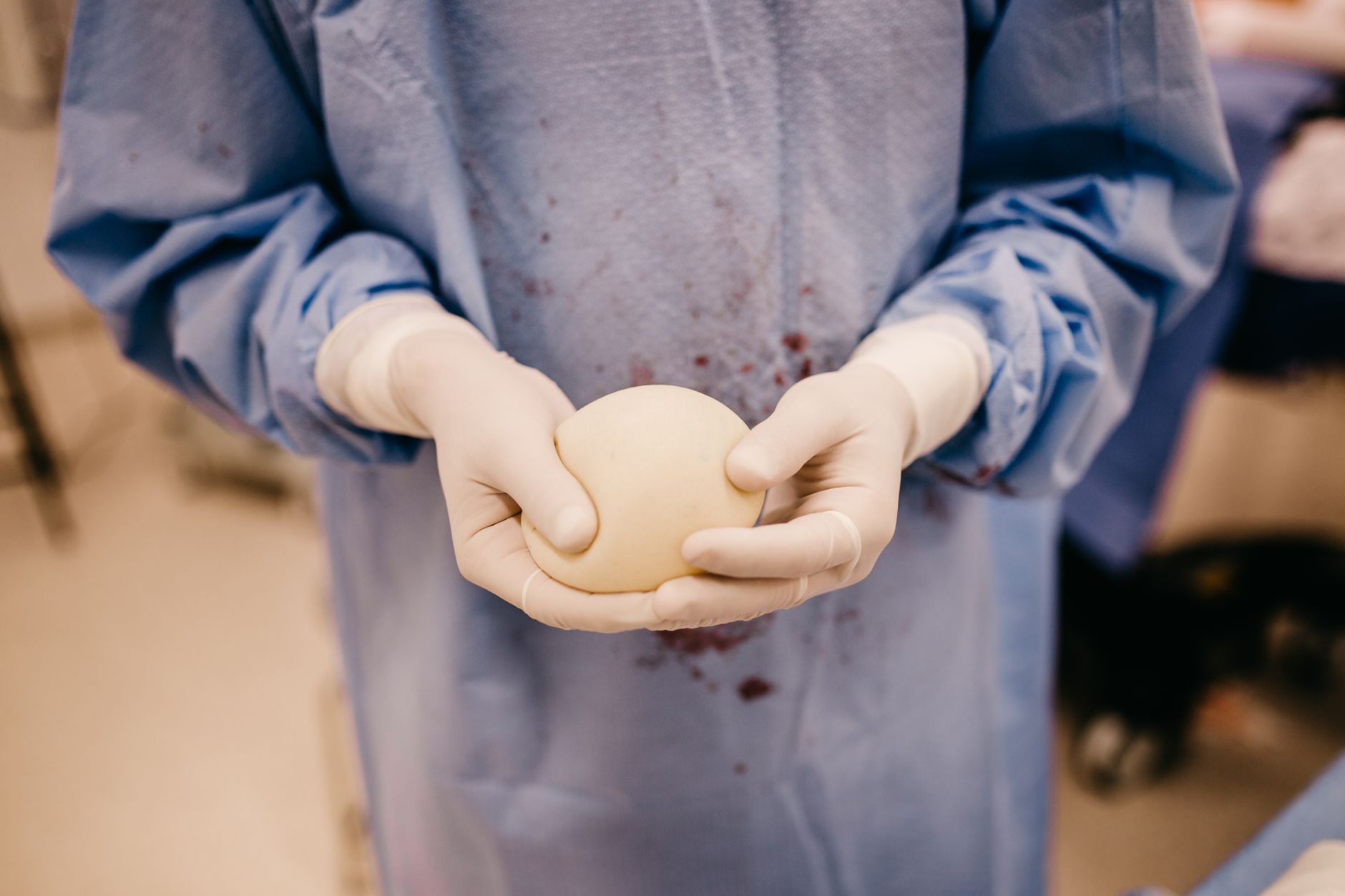
The implant pocket is the internal space that contains the breast implant.
In symmastia, the pocket is often too large medially, but the deformity may extend in several directions.
Pocket reconstruction may therefore include:
The ultimate goal is to create a pocket that fits the implant precisely.
An implant sitting inside an oversized pocket will continue to move. A reconstructed pocket provides the boundaries necessary to hold the implant in the intended position.
Symmastia Repair
Two decisions that shape the result
Right-sized implant selection and internal mesh reinforcement — the two pillars of a lasting symmastia repair.
01 · Choosing the Right Implant for Symmastia Repair
Implant selection is an important part of long-term success.
If the original implant is too wide for the patient’s chest, returning the same implant to a repaired pocket may simply reproduce excessive pressure on the reconstruction.
During planning, Dr. Burns considers:
Some patients can maintain similar breast volume by switching to an implant with more appropriate dimensions.
Others benefit from downsizing.
The goal is not automatically to make the breasts smaller. The goal is to match implant dimensions to the reconstructed pocket and the patient’s natural anatomy.
Patients interested in newer implant options can also learn about
Motiva breast augmentation in Dallas02 · The Role of an Internal Mesh Bra
Revision surgery sometimes requires additional reinforcement because the patient’s tissues have already been stretched, weakened, or operated on multiple times.
An internal surgical mesh may be used as a scaffold to help reinforce the reconstructed pocket.
Reinforcement may support:
- The medial breast border
- The lower breast fold
- The lower pole
- The overall implant pocket
Potential purposes include:
- Supporting the pocket reconstruction
- Reducing tension on sutures
- Improving implant stability
- Reinforcing weak tissues
- Helping protect the medial repair
- Supporting the inframammary fold
- Reducing recurrent malposition risk
Importantly, mesh is not a substitute for accurate pocket reconstruction.
The foundation remains meticulous surgery. Mesh is an additional reinforcement when the patient’s tissues require greater structural support.
Symmastia and Other Breast Implant Malposition Problems
Many patients with symmastia have more than one implant-position problem.
01
Bottoming Out
The implant sits too low and stretches the lower breast.
02
Lateral Displacement
The implant moves excessively toward the side or armpit.
03
Double-Bubble Deformity
A secondary crease or contour develops beneath the breast.
04
Animation Deformity
The implant changes shape or position when the pectoralis muscle contracts.
05
Capsular Contracture
The scar capsule around the implant becomes abnormally tight, which can distort the breast or move the implant.
Dr. Burns also treats capsular contracture as part of his breast revision practice; his current educational article discusses implant distortion, firmness, pain, and the potential need for surgical correction.
Related reading:
Capsular Contracture After Breast AugmentationSymmastia correction
Recovery & Postoperative Care
Why Postoperative Care Is Critical
A technically successful repair still needs time to heal.
During the early postoperative period, the sutures and reconstructed tissues are supporting the implants while scar tissue gradually strengthens the new pocket.
Postoperative recommendations may include:
The central repair is particularly vulnerable during early healing.
Feeling comfortable does not necessarily mean the internal tissues are fully healed.
Protecting the reconstruction during this period can be just as important as the surgery itself.
Recovery After Symmastia Correction
Recovery depends on how extensive the revision is.
A relatively focused pocket repair is different from surgery that includes:
Most patients should expect some combination of:
The breasts may initially look slightly higher, tighter, or more separated than expected.
That can be intentional. The reconstructed pocket must hold the implant securely while the tissues heal and soften.
Visible swelling often improves over the first several weeks, while the internal pocket continues to mature for months.
Patient education
Understanding symmastia correction
A clear, honest look at recurrence risk, the value of revision experience, and what successful correction aims to achieve.
01
Can Symmastia Come Back?
Recurrence is possible because symmastia involves tissue that has already been weakened.
Factors that may increase recurrence risk include:
There is no procedure that can guarantee symmastia will never recur.
The goal is to reduce that risk through thoughtful implant selection, precise pocket reconstruction, appropriate reinforcement, and disciplined postoperative care.
02
Why Experience Matters in Secondary Breast Surgery
Secondary breast augmentation is fundamentally different from primary breast augmentation.
The surgeon is no longer working with untouched anatomy. Previous surgery may have changed:
Dr. John L. Burns Jr., MD, FACS is a board-certified Dallas plastic surgeon with more than 25 years of experience and a practice that includes extensive cosmetic breast and revision work. His website specifically notes significant experience with breast revisions and corrections.
Revision patients may present with:
The correct operation is therefore not standardized.
The philosophy is to determine why the previous augmentation failed and correct the structural cause rather than simply replacing the implant.
03
The Goal: Natural Cleavage, Better Shape and Long-Term Stability
Successful symmastia correction is not simply about moving the implants farther apart.
The goal is to restore a natural breast architecture.
A well-planned correction aims for:
The best revision results are both aesthetic and structural.
The breasts should look better, but the internal support system must also be rebuilt so the result has the best opportunity to remain stable.
Patient FAQ
Frequently Asked Questions About Symmastia Correction
Expand the questions below to learn more about symmastia correction and what to expect.
Breast Revision & Secondary Breast Surgery
Schedule a Symmastia Correction Consultation in Dallas
Dr. John L. Burns Jr., MD, FACS specializes in cosmetic breast surgery and complex breast revision in Dallas.
During your consultation, Dr. Burns will evaluate:
Your treatment plan may include:
The objective is not simply to separate the breasts. It is to restore natural cleavage, balanced breast shape, and a stable implant pocket.
John L. Burns Jr., MD, FACS
Board-Certified Plastic Surgeon
Breast Revision & Secondary Breast Surgery
Dallas, Texas
Ready to Correct a Previous Breast Augmentation?
Phone: 214-515-0002
Website: https://drjohnburns.com