
FACIAL FAT GRAFTING
Facial Fat Grafting: Natural Volume Restoration Using Your Own Fat
How structural fat, microfat, and nanofat can restore youthful facial volume without creating an overfilled appearance
Facial aging involves a gradual loss of facial fat in the temples, cheeks, lower eyelids, lips and jawline. Restoring that lost volume with your own tissue can matter as much as tightening loose skin. Because the graft is your own fat, the goal is to replace what aging took away — not to add volume you never had.
SCHEDULE A FACIAL FAT GRAFTING CONSULTATIONJohn L. Burns Jr., MD, FACS · Board-certified plastic surgeon · 25+ years in facial rejuvenation
What Is Facial Fat Grafting?
Facial fat grafting, also known as autologous fat transfer, involves harvesting a small amount of fat from one area of the patient's body, preparing it, and carefully transferring it into areas of facial volume loss.
Fat is commonly harvested through gentle liposuction from areas such as the:
- Abdomen
- Flanks
- Inner thighs
- Outer thighs
The harvested fat is then processed before being strategically placed into specific areas of the face.
Dr. Burns' existing facial-fat-grafting technique uses the Tulip system and different fat preparations according to the area being treated.
Because the material originates from the patient's own body, facial fat grafting is fundamentally different from injecting a manufactured dermal filler.
It is living tissue being used to restore living tissue.
Why Does the Face Lose Volume With Age?
Aging is not simply the process of developing wrinkles.
The face changes at multiple anatomical levels.
Over time, patients may experience:
- Loss of subcutaneous facial fat
- Changes in deeper facial fat compartments
- Changes in facial bone support
- Ligament laxity
- Reduced collagen
- Thinner skin
- Descent of facial tissues
The result can be a face that looks flatter, more angular, hollow, or tired.
This explains why simply tightening loose skin does not always create complete facial rejuvenation.
A patient may have beautifully repositioned facial tissue but still look older if the cheeks remain flat, the temples are hollow, or a deep depression remains between the lower eyelid and cheek.
Modern facial rejuvenation therefore increasingly considers two separate components of aging:
Descent + Deflation
And, when appropriate, treatment may require:
Repositioning + Restoration
This concept is also central to Dr. Burns' Lift & Fill Facelift, which combines facial lifting with restoration of lost facial volume.
EXPLORE THE LIFT & FILL FACELIFTWhy Fat Can Look So Natural in the Face
One of the greatest advantages of facial fat transfer is the quality of the result. Fat naturally exists throughout the face.
- When facial fat grafting is performed appropriately, the goal is essentially to restore volume to areas where aging has depleted it.
- That can produce a soft, natural transition rather than simply filling an individual wrinkle.
- This is especially valuable for patients concerned about looking overfilled.
- The objective is not to change the shape of the face unnecessarily or erase every line.
It is to restore more youthful facial proportions while preserving the patient's identity.
Fat Is Living Tissue
There is another important distinction between facial fat grafting and traditional filler. Fat is living tissue.
After transplantation, a portion of the graft establishes a new blood supply and survives within the recipient area. The surviving graft then behaves similarly to other fat within the body.
That means established fat can:
- Change with significant weight gain or loss
- Age with the surrounding facial tissues
- Provide long-term volume in areas where the graft survives
Not every transferred fat cell survives, which is why fat-grafting technique matters tremendously. But the portion that successfully establishes a blood supply can provide a long-lasting form of facial volume restoration.
Fat Allows Comprehensive Facial Rejuvenation
Dermal fillers are typically purchased by the syringe. That works extremely well when a patient needs a small, highly targeted correction.
But what happens when aging has affected the entire face? A patient might simultaneously have:
- Hollow temples
- Flattened cheeks
- Lower-eyelid hollows
- Deepening nasolabial folds
- Perioral volume loss
- Pre-jowl hollowing
- Loss of jawline support
Attempting to correct substantial global facial deflation with filler alone may require multiple syringes. Fat offers a different strategy.
Even a relatively small liposuction harvest can provide enough material to address numerous facial compartments. Instead of chasing individual wrinkles, Dr. Burns can approach the face three-dimensionally.
Where Can Facial Fat Grafting Be Used?
Fat grafting is remarkably versatile, but every area of the face requires a different approach.

Temples
Temporal hollowing can make the upper face appear thinner, older, or more skeletal. Restoring appropriate volume can create a smoother transition between the forehead, temple, and cheek.
Brow and Upper Eyelid Area
Loss of volume around the brow and upper orbit can create a hollow or aged appearance. Carefully placed fat may help restore softness to this area.
Lower Eyelids and Tear Troughs
The depression between the lower eyelid and cheek is one of the most important transitions in facial aging. Fat grafting can be used to soften this junction and restore a smoother contour in appropriately selected patients.
Midface and Cheeks
The cheeks are among the most structurally important areas of the face. Restoring volume can improve cheek projection while helping reestablish youthful proportions between the lower eyelid, cheek, and lower face.
Nasolabial Folds
Fat can help soften the transition between the cheek and the folds extending from the nose toward the mouth.
Marionette Area
Loss of support around the corners of the mouth can exaggerate a downturned or aged appearance. Strategic volume restoration can soften these transitions.
Lips and Perioral Area
Small quantities of carefully prepared fat may be used to restore age-related lip volume and address selected changes around the mouth.
Chin and Jawline
Deeper fat placement can be used strategically to support selected areas of the chin and jawline.
Pre-Jowl Area
Loss of volume immediately in front of the jowl can make jowling appear more prominent. Restoring this transition can contribute to a smoother lower-face contour.
Dr. Burns' current facial-fat-transfer material identifies the temples, lower eyelid/cheek region, midface, nasolabial folds, marionette areas, chin and jawline among the common areas treated with fat grafting.
VIEW FACIAL FAT TRANSFER BEFORE & AFTER PHOTOSNot All Fat Grafting Is the Same
This is where modern facial fat grafting becomes particularly interesting.
A cheek and a lower eyelid should not necessarily be treated with the same type of fat.
The cheek may require deeper structural support.
The lower eyelid involves considerably thinner, more delicate tissue.
Dr. Burns uses the Tulip fat-processing system to prepare different consistencies of fat according to the anatomical area and desired treatment depth.
This allows him to work with three broad categories:
Structural Fat
Placed deeper to rebuild structural support, which suits areas such as the cheek.
Microfat
A finer preparation, used for more delicate, superficial placement.
Nanofat
The finest preparation, used where tissue is thinnest and most delicate, such as the lower eyelid.
Each has a different role.
Structural Fat: Rebuilding Facial Architecture
Traditional or less-filtered structural fat can be used when greater volume and deeper support are required.
Dr. Burns may place this fat deeply within appropriate tissue planes or over areas of facial bone.
The goal in these areas is not simply filling a line.
It is rebuilding the deeper architecture that contributes to youthful facial shape.

Potential applications include:
- Cheeks
- Midface
- Chin
- Jawline
- Larger areas of facial deflation
What Is Microfat?
Microfat is processed into smaller fat particles that can be delivered through smaller cannulas.
This gives the surgeon greater precision and can allow treatment of areas where traditional structural fat would be too coarse.
Dr. Burns may use microfat for areas such as:
- Temples
- Nasolabial folds
- Marionette lines
- Selected cheek areas
- Smaller contour deficiencies
Dr. Burns' existing facial-fat-grafting page describes microfat as a more refined preparation used for delicate areas and moderate-volume correction.
The ability to control particle size makes contemporary fat grafting far more sophisticated than simply injecting the same preparation throughout the entire face.
Potential treatment areas can include:
- Lower eyelids
- Tear trough region
- Fine lines
- Upper eyelid area
- Perioral region
- Lips
- Selected scars
- Areas where skin quality is a particular concern
What Is Nanofat?
Nanofat is processed even further.
Unlike structural fat, nanofat is not primarily intended to create significant bulk volume.
Its very fine consistency allows it to be used in more superficial and delicate tissues.
The important distinction is that nanofat is not simply tiny filler.
Its role differs from structural fat.
Dr. Burns' current technique uses finer preparations for delicate areas such as the lower eyelids and lips, while denser fat is used for deeper areas requiring more volume.

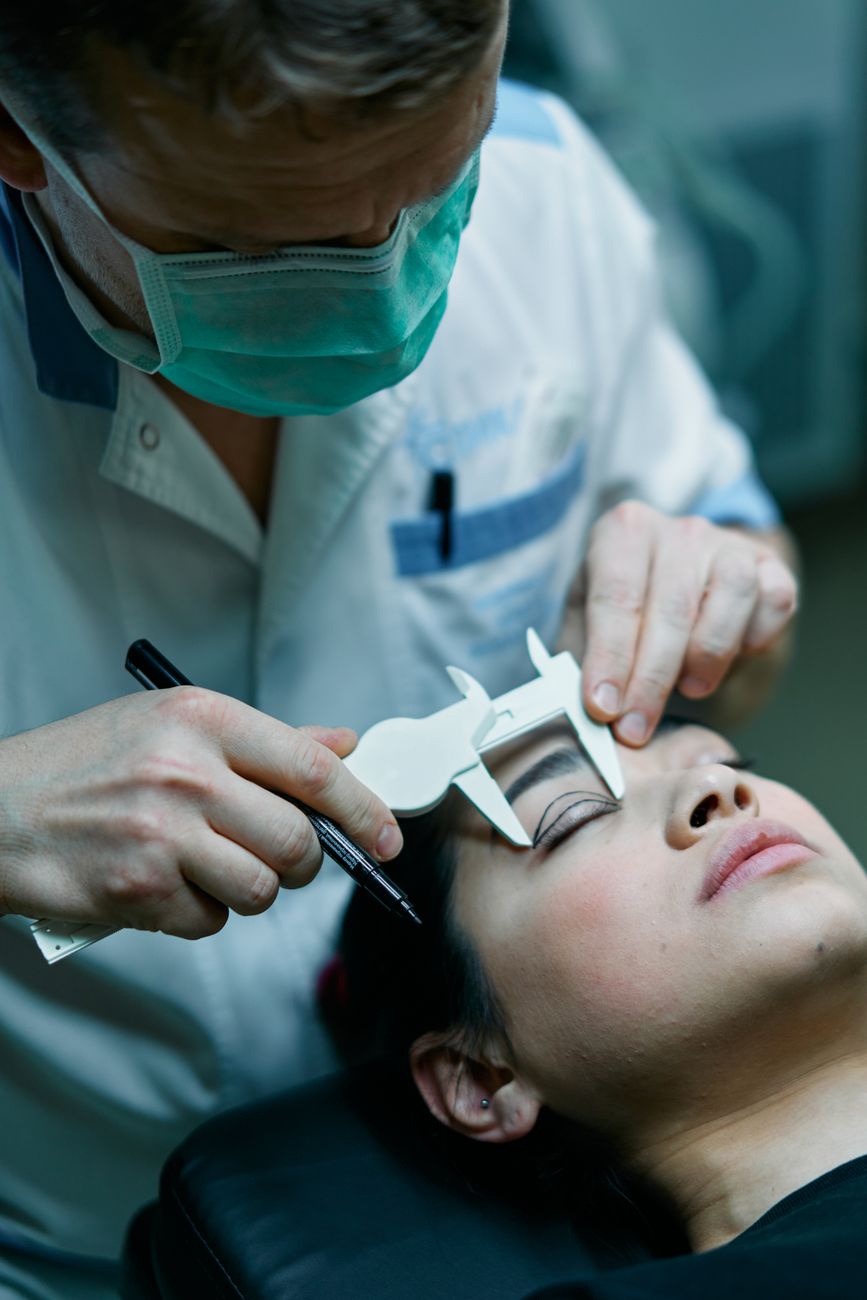
Dr. Burns assessing facial fat-grafting treatment areas on a patient.
STRUCTURAL FAT
Deep support + architecture
Chosen when a deeper layer needs structural support and volume, as in the midface and cheeks.
MICROFAT
Refined volume + precision
Chosen when a smaller particle size and greater precision are needed, as in the temples and nasolabial folds.
NANOFAT
Delicate superficial applications
Chosen for superficial and delicate tissues, as in the lower eyelids, tear troughs and lips.
Fat Contains More Than Fat Cells
Adipose tissue is biologically complex.
It contains not only mature fat cells but also a stromal vascular fraction containing different cell populations and signaling components.
This is one reason fat grafting has attracted considerable interest within regenerative medicine.
However, it is important to separate promising biology from exaggerated marketing.
Terms such as "stem-cell facelift" can imply a degree of proven rejuvenation that exceeds what should be promised to patients.
The most established purpose of facial fat grafting remains straightforward:
Natural volume restoration using the patient's own tissue.
Potential changes in overlying tissue quality remain an area of continued clinical and scientific interest.
The Tulip System: Customizing Fat for Different Facial Layers
Dr. Burns uses the Tulip system to prepare harvested fat into different consistencies.
This matters because facial anatomy varies dramatically from one region to another.
The thick tissues over the cheekbone are very different from the delicate tissues beneath the lower eyelid.
With different fat preparations, Dr. Burns can select a consistency appropriate for the treatment area rather than attempting to use one type of fat everywhere.
His current facial-fat-grafting approach uses unfiltered fat for deeper structural areas and more refined microfat and nanofat preparations for progressively more delicate applications.
The result is a layered approach to facial restoration.
Facial Fat Grafting vs. Dermal Filler: Which Is Better?
Neither treatment is universally better.
They solve different problems.
Dermal Filler May Be Better When | Fat Grafting May Be Better When |
|---|---|
A small correction is needed | Multiple facial areas have lost volume |
An office-based treatment is preferred | Substantial volume restoration is needed |
No fat harvest is desired | Natural tissue is preferred |
A highly targeted area needs correction | Comprehensive facial restoration is desired |
HA reversibility is important | Fat transfer is being combined with surgery |
Temporary correction is acceptable | Longer-lasting restoration is preferred |
Dermal Filler May Be Better When
- A small correction is needed
- An office-based treatment is preferred
- No fat harvest is desired
- A highly targeted area needs correction
- HA reversibility is important
- Temporary correction is acceptable
Fat Grafting May Be Better When
- Multiple facial areas have lost volume
- Substantial volume restoration is needed
- Natural tissue is preferred
- Comprehensive facial restoration is desired
- Fat transfer is being combined with surgery
- Longer-lasting restoration is preferred
Dr. Burns uses both approaches.
The decision should be based on the patient's anatomy, goals, degree of facial deflation, tolerance for downtime, and whether other facial surgery is being performed.
Why Fat Grafting and Facelift Surgery Work So Well Together
A facelift and facial fat grafting solve two fundamentally different problems.
A facelift primarily addresses descent.
Fat grafting primarily addresses deflation.
A facelift can reposition:
- Jowls
- Lower-face tissues
- Neck tissues
- Deeper facial support structures
Fat grafting can simultaneously restore volume to:
- Temples
- Cheeks
- Lower-eyelid/cheek junction
- Perioral areas
- Chin
- Jawline
This is the foundation of Dr. Burns' Lift & Fill philosophy.
His dedicated Lift & Fill page describes the approach as a three-dimensional strategy combining facial lifting with volume restoration in areas including the cheeks, brow, tear troughs, and temples.
Why Simply Pulling the Face Tighter Isn't Enough
Youthful faces are not simply tighter.
They are also appropriately full.
Pulling a significantly deflated face tighter without addressing lost volume can fail to restore the soft contours associated with youth.
Modern facial rejuvenation therefore recognizes two processes:
Aging
Descent + Deflation
Rejuvenation
Repositioning + Restoration
This does not mean every facelift patient requires large amounts of fat.
It means that the surgeon should evaluate both where tissue has fallen and where volume has disappeared.
Natural Does Not Mean Overfilled
Having an abundant source of fat does not mean all of it should be injected.
Restraint is critical.
Dr. Burns evaluates factors including:
- Facial proportions
- Bone structure
- Existing fat compartments
- Skin thickness
- Degree of aging
- Previous filler
- Facial balance
- Individual aesthetic goals
The goal is not an unnaturally round or swollen face.
The goal is to restore the volume that has been lost while maintaining the patient's individual facial identity.
Ideally, people notice that the patient looks refreshed, not that they have been "filled."
How Much Transferred Fat Survives?
Not every transplanted fat cell will survive.
Some portion of the transferred fat is naturally reabsorbed during healing.
Fat survival can be influenced by factors including:
- Harvest technique
- Processing
- Injection technique
- Recipient tissue
- Blood supply
- Smoking
- Individual healing
- Treatment area
- Amount and distribution of fat placed
For fat to survive, transferred tissue must establish an adequate blood supply.
This is why facial fat grafting should be thought of as a surgical technique, not simply as another injectable treatment.
Is Facial Fat Transfer Permanent?
The portion of fat that successfully survives and establishes a blood supply can be very long lasting.
Unlike temporary hyaluronic acid filler, there is not necessarily a predetermined date when all surviving transferred fat disappears.
However, transferred fat remains living tissue.

It continues to respond to:
- Weight changes
- Hormonal changes
- Aging
- Changes in surrounding tissues
Fat grafting therefore does not freeze the face in time.
It restores volume and allows the patient to continue aging from a different starting point.
Patients may notice:
- Hollow temples
- Flattened cheeks
- More prominent lower-eyelid hollows
- Deepening facial folds
- Loss of jawline support
- A thinner or more skeletal appearance

Facial Fat Grafting After GLP-1 or Significant Weight Loss
Significant weight loss can reveal facial deflation that was previously less apparent.
The popular phrase "Ozempic face" can be misleading because these facial changes are not exclusive to one medication. Similar changes may occur following substantial weight loss from many causes.
For appropriately selected patients, facial fat grafting can be particularly useful because it allows Dr. Burns to restore several depleted facial compartments during the same procedure.
DrJohnBurns.com already has a dedicated post-GLP-1 body-contouring resource that discusses facial volume loss and the use of structural, micro-, and nanofat as part of facial restoration after weight loss.
What Are the Risks of Facial Fat Grafting?
Although fat grafting uses the patient's own tissue, it remains a surgical procedure.
Fat injection can also carry rare but potentially serious vascular complications.
Detailed knowledge of facial anatomy, careful technique, appropriate injection planes, and surgical experience are therefore essential.

Potential risks can include:
- Swelling
- Bruising
- Infection
- Asymmetry
- Under-correction
- Over-correction
- Contour irregularities
- Fat necrosis
- Oil cysts
- Partial graft resorption
- Need for additional treatment
Facial fat transfer should not be viewed as simply an interchangeable substitute for a routine filler appointment.
Who Is a Good Candidate for Facial Fat Grafting?
Facial fat grafting may be appropriate for patients experiencing:
- Hollow temples
- Flattened cheeks
- Lower-eyelid hollows
- Age-related facial deflation
- Deepening nasolabial folds
- Perioral volume loss
- Thin or deflated lips
- Pre-jowl hollowing
- Loss of chin or jawline support
- Significant weight-loss-related facial deflation
- GLP-1-associated facial volume changes
It may also be particularly useful for patients undergoing a facelift, neck lift, or eyelid procedure who would benefit from simultaneous restoration of lost facial volume.
Because the grafted fat is the patient's own tissue, the result is intended to restore volume gradually and to sit naturally within the existing facial structure rather than to change its proportions.
Facial Fat Grafting FAQs
Common questions about facial fat grafting, answered by Dr. Burns.
Why Choose Dr. John Burns for Facial Fat Grafting in Dallas?
Facial fat grafting requires more than the ability to harvest and inject fat.
It requires an understanding of how the face ages three-dimensionally.
John L. Burns Jr., MD, FACS is a board-certified plastic surgeon with more than 25 years of experience in facial rejuvenation, facial fat transfer, facelift surgery, and aesthetic plastic surgery.

His approach allows different preparations to be selected according to the anatomical need:
- Structural fat for deeper facial support.
- Microfat for refined volume restoration.
- Nanofat for delicate superficial applications.
Using the Tulip system, Dr. Burns can customize the fat preparation according to both treatment depth and facial anatomy.
His facial fat-grafting practice includes treatment of:
- Temples
- Eyelid and cheek region
- Cheeks
- Midface
- Nasolabial folds
- Marionette areas
- Lips
- Chin
- Jawline
The goal is comprehensive facial restoration rather than simply filling isolated wrinkles.
The Bottom Line: Replace What Aging Has Taken Away
Facial aging is not only about loose skin.
It is also about lost volume.
Facial fat grafting gives appropriately selected patients an opportunity to restore that volume using their own tissue.
Modern techniques allow fat transfer to be approached at multiple levels:
Structural fat for architecture.
Microfat for precision.
Nanofat for delicate superficial applications.
For patients undergoing more comprehensive facial rejuvenation, fat grafting can also complement facelift, neck lift, and eyelid surgery by addressing a problem that lifting alone cannot correct: deflation.
The goal is not to create a new face.
It is to restore the soft contours, proportions, and balance that made the face look youthful in the first place.
Schedule a Facial Fat Grafting Consultation in Dallas
If you are bothered by facial hollowing, flattened cheeks, lower-eyelid depressions, age-related volume loss, or facial changes following significant weight loss, Dr. Burns can determine whether facial fat grafting, dermal filler, facelift surgery, or a combination approach is best suited to your anatomy and goals.
John L. Burns Jr., MD, FACS
Board-Certified Plastic Surgeon
Facial Rejuvenation & Fat Transfer Specialist
Dallas, Texas