
Laser Treatments & Skin Rejuvenation
Fully Ablative CO2 vs. Erbium Laser Resurfacing: Which Is Right for You?
Hai công nghệ resurfacing mạnh mẽ. Hai cách tiếp cận trẻ hóa da khác nhau. Một triết lý điều trị cá nhân hóa.
Not all lasers are created equal. Some patients want softer fine lines, even pigmentation and a smoother complexion with downtime they can manage. Others need deeper wrinkles, sun damage or advanced aging addressed. Both are fully ablative options offered at John Burns, MD, PA and Jola Aesthetics in Dallas.
SCHEDULE A LASER CONSULTATIONBoard-certified plastic surgeon with 25+ years of aesthetic and laser rejuvenation experience, Dallas.
What Does Fully Ablative Laser Resurfacing Mean?
Fully ablative laser resurfacing removes the continuous surface of the skin across the entire treated area in a controlled manner. Rather than leaving islands of untreated skin between columns of injury, the laser passes over the full field, so the resurfacing effect is uniform from edge to edge.
This is what separates it from fractional laser resurfacing, which creates microscopic treatment zones separated by untreated skin. Fractional devices rely on that untreated tissue to speed healing; fully ablative treatment does not, which is why the two approaches behave so differently during recovery.
Because the entire surface of the selected area is treated, improvement can be substantial in the following:
- fine lines and deeper wrinkles
- sun damage and uneven pigmentation
- rough or irregular skin texture
- certain acne scars
- crepey skin
- selected superficial scars
- overall skin quality
- collagen remodeling and tightening
The tradeoff is recovery.
Fully ablative resurfacing creates a controlled wound that must heal. Compared with lighter fractional or nonablative treatments, patients generally face more downtime and a greater risk of complications, which is why the decision is made carefully with a clinician rather than casually.
Both CO2 and Erbium lasers work by targeting water within the skin, but their different wavelengths produce distinct patterns of tissue ablation and residual heating. Those differences are what make each laser valuable, and they are the reason the choice between them is a clinical one rather than a matter of one being simply stronger than the other.
Fully Ablative CO2 Laser Resurfacing: Powerful Skin Renewal and Collagen Remodeling
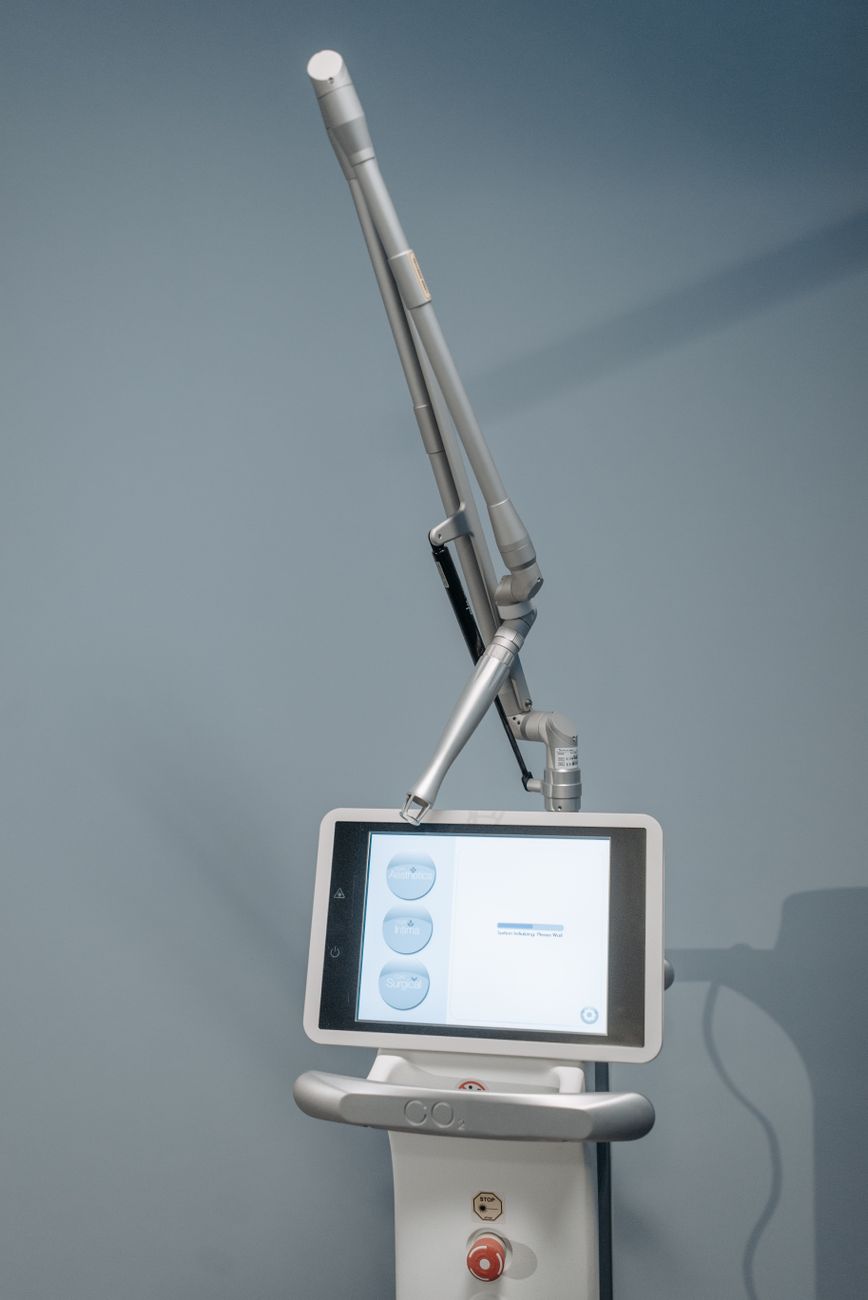
Fully ablative CO2 laser resurfacing is one of the most powerful ways to achieve tighter, smoother, more even skin. The laser operates at approximately 10,600 nanometers, and its energy is absorbed by water in the skin to produce controlled vaporization of tissue.

~10,600 nm
CO2 wavelength
Energy is absorbed by water within the skin.
CO2 carries a substantial residual thermal zone, unlike Erbium.
What Are the Benefits of Fully Ablative CO2?
CO2 laser resurfacing may be particularly effective for patients with
Moderate to severe wrinkles
Deeper facial wrinkles including established lines around the mouth can be challenging to treat with skincare, injectables or lighter lasers, and CO2 resurfacing can provide substantial improvement in selected patients.
Advanced sun damage
Years of ultraviolet exposure can produce irregular pigmentation, rough texture, wrinkles and significant deterioration in skin quality, and fully ablative resurfacing removes damaged surface tissue and promotes new epidermal tissue during healing.
Acne scarring
Certain types of acne scars may improve through controlled tissue removal and collagen remodeling, results depend on scar type and depth, and some scars require additional treatments.
Crepey skin and textural changes
CO2 can improve fine crepiness and surface irregularities while producing a degree of collagen contraction.
More pronounced facial aging
Patients seeking a substantial resurfacing result may benefit from the greater thermal remodeling associated with CO2.
Why CO2 Can Produce More Skin Tightening
The distinction between CO2 and Erbium is not simply how much skin each removes but also what happens to the surrounding tissue. CO2 produces residual heat that can contract existing collagen and stimulate additional remodeling during healing. This is one reason it can be particularly valuable for deeper wrinkles and more advanced skin aging.
However, the same thermal effect that contributes to its effectiveness also influences recovery.
What Are the Risks of Fully Ablative CO2 Laser Resurfacing?
Aggressive CO2 resurfacing requires careful patient selection and meticulous postoperative care, and potential complications include
Prolonged redness
Swelling
Post-inflammatory hyperpigmentation
Hypopigmentation, which may be persistent
Infection
Delayed wound healing
Acne or milia
Scarring
Textural irregularities
Reactivation of herpes simplex
Persistent pigment changes
Because CO2 creates greater residual thermal injury than conventional Erbium ablation, recovery may be longer, and patients with darker skin tones or a history of pigmentary changes may have increased risks with aggressive ablative resurfacing.
The objective is never to use the highest possible laser setting. It is to achieve meaningful improvement while minimizing unnecessary injury.
CO2 vs. Erbium Laser Resurfacing: The Key Differences
Một cách hữu ích để hiểu hai công nghệ này là:
CO2 combines tissue ablation with greater residual thermal heating.
Erbium provides highly precise ablation with less residual thermal heating.
That distinction influences treatment results, recovery, and risk.
Feature | Fully Ablative CO2 | Fully Ablative Erbium:YAG |
|---|---|---|
Wavelength | 10,600 nm | 2,940 nm |
Primary action | Ablation + thermal remodeling | Precise ablation |
Residual thermal injury | Generally greater | Generally less |
Collagen contraction | Often more pronounced | Generally more limited |
Fine wrinkles | Excellent | Excellent |
Deeper wrinkles | Particularly useful | May require deeper or repeated treatment |
Advanced sun damage | Excellent | Excellent |
Acne scars | Useful for selected scars | Useful for selected scars |
Healing | Generally longer | Often faster |
Redness | May persist longer | Often resolves sooner |
Pigmentary complications | Important concern, particularly with aggressive treatment | Still possible, but often less thermal injury |
Ideal treatment philosophy | More intensive resurfacing and remodeling | Precise resurfacing with less thermal spread |
Swipe the table sideways to compare all columns.
Important: These comparisons describe general differences between conventional fully ablative approaches. Actual outcomes depend on device settings, treatment depth, passes, patient characteristics, and aftercare.
Which Laser Produces Better Results?
There is no universal winner.
The better laser is the one that addresses the patient's specific skin concerns while maintaining an appropriate safety profile.
CO2 May Be Better for Deeper Wrinkles and Advanced Skin Aging
Patients with pronounced wrinkles, significant photodamage, or more substantial textural changes may benefit from the greater thermal remodeling associated with CO2.
This can be particularly useful for etched-in wrinkles around the mouth.
However, patients must be willing to accept the recovery and potential risks associated with more aggressive treatment.
Erbium May Be Better for Precision and Potentially Faster Healing
Patients with fine-to-moderate wrinkles, superficial textural irregularities, and sun-damaged skin may be excellent candidates for Erbium.
Its precise ablation profile can provide significant surface rejuvenation while limiting residual thermal injury.
For some patients, that balance is more desirable than pursuing the most aggressive possible treatment.
The Best Choice Depends on More Than Wrinkle Depth
During consultation, Dr. Burns evaluates:
Skin type and pigmentation history
Degree of photodamage
Wrinkle depth
Skin thickness
Presence of scarring
Previous laser treatments
Medical history
Recovery expectations
Desired degree of correction
These factors help determine whether CO2, Erbium, fractional resurfacing, or a lighter treatment is appropriate.
How Much Downtime Should You Expect?
Recovery is one of the most important considerations when choosing an ablative laser.
Unlike nonablative treatments, fully ablative resurfacing removes the treated epidermal surface and creates an open healing area.
Patients should expect redness, swelling, sensitivity, and a period of wound care.
Fully Ablative CO2 Recovery
- Depending on treatment intensity, the initial resurfaced skin may take approximately 7–14 days or longer to re-epithelialize.
- Swelling and crusting occur during early healing.
- Redness may persist for weeks or, following aggressive treatments, several months.
- Final improvements in texture and collagen remodeling develop gradually.
Fully Ablative Erbium Recovery
- Erbium may allow somewhat faster re-epithelialization because of its more limited residual thermal injury.
- Some patients heal within approximately 5–10 days, although deeper treatments can require longer.
- Redness and sensitivity can persist beyond the initial healing period.
These timelines are broad estimates rather than guarantees. Treatment intensity and individual healing can change recovery substantially.
Neither treatment should be considered a lunchtime laser procedure.
Why Having Both CO2 and Erbium Lasers Matters
One of the advantages of receiving treatment at Dr. Burns' practice and Jola Aesthetics is access to multiple resurfacing technologies.
Many practices rely on a single resurfacing platform.
When only one laser is available, treatment recommendations may naturally revolve around that device.
At Jola Aesthetics, we can approach the decision differently.
"How can we use this laser to treat the patient?"
"Which laser is most appropriate for this patient's skin?"
For example, a patient with deep perioral wrinkles may benefit from a different resurfacing strategy than a patient with superficial sun damage and fine lines.
A patient who prioritizes maximum correction may accept a longer recovery.
Another patient may prefer a more conservative approach.
Having both technologies allows treatment planning to begin with the patient rather than the equipment.
Where Does Our New eCO2 3D Laser Fit In?
The introduction of the Cynosure Lutronic eCO2 3D at Jola Aesthetics expands our laser resurfacing options even further.
The eCO2 3D is a fractional CO2 laser platform designed to provide customizable treatment depth, density, and delivery.
The eCO2 3D is a fractional CO2 laser platform designed to provide customizable treatment depth, density, and delivery.
Its features include:
- Three microbeam spot sizes
- Static treatment mode
- Dynamic treatment mode
- Adjustable treatment intensity
- Controlled Chaos™ scanning technology
- Lighter Precision Peel treatment options
The eCO2 3D allows us to perform treatments across a broad spectrum, from relatively lighter fractional resurfacing to more intensive fractional treatments.
However, fractional CO2 resurfacing and fully ablative CO2 resurfacing are not interchangeable.
Fractional treatment leaves areas of untreated skin between treatment zones.
Fully ablative resurfacing removes the continuous treated surface.
For some patients, fractional CO2 provides an appealing compromise between improvement and downtime.
For others, full-field resurfacing may be appropriate.
What About Ultra Laser Treatments?
Not every patient needs fully ablative resurfacing.
For patients with milder pigmentation, sun damage, dullness, and early textural changes, a nonablative laser may be more appropriate.
At Jola Aesthetics, the Ultra 1927 nm thulium laser offers another approach to skin rejuvenation.
At Jola Aesthetics, the Ultra 1927 nm thulium laser offers another approach to skin rejuvenation.
Ultra can address concerns such as:
- Sun damage
- Uneven pigmentation
- Fine lines
- Rough texture
- Dullness
- Enlarged-appearing pores
Because Ultra is nonablative, it generally involves less recovery than aggressive fully ablative resurfacing.
This creates a useful range of treatment options.
Ultra:
Lower-downtime skin rejuvenation.
Fractional eCO2 3D:
Customizable fractional resurfacing.
Fully Ablative Erbium:
Precise full-field resurfacing with less residual thermal injury.
Fully Ablative CO2:
Intensive resurfacing with greater thermal collagen remodeling.
The appropriate treatment depends on the patient's skin and goals.
Who Is a Good Candidate for Aggressive Laser Resurfacing?
Fully ablative resurfacing is generally best suited for healthy patients who have meaningful skin concerns and understand the recovery process.
Potential candidates include patients with:
Moderate to severe facial wrinkles
Advanced sun damage
Rough or uneven texture
Selected acne scars
Crepey facial skin
Significant photoaging
Realistic expectations
The ability to follow detailed postoperative instructions
However, not everyone is an appropriate candidate.
Skin Type and Pigmentation
Patients with darker Fitzpatrick skin types may face increased risks of post-inflammatory hyperpigmentation and other pigmentary changes following aggressive ablative treatment.
This does not automatically exclude every patient with darker skin, but it makes individualized assessment especially important.
Sun Exposure
Patients must be willing to carefully protect treated skin from ultraviolet exposure before and after resurfacing.
Medical History
A history of abnormal scarring, certain medications, active infections, or impaired wound healing may influence candidacy.
Recovery Commitment
Patients must be prepared for wound care, activity restrictions, and a period during which the skin remains visibly red and sensitive.
Realistic Expectations
Laser resurfacing can improve skin quality and certain wrinkles.
It cannot replace a facelift when the primary concern is significant tissue descent, jowling, or neck laxity.
Can Laser Resurfacing Be Combined With a Facelift?
Yes, in carefully selected patients.
Facial aging occurs at multiple levels.
Some changes involve the surface of the skin.
Others involve deeper structures.
A facelift primarily addresses:
- Jowling
- Lower-face tissue descent
- Loose neck tissues
- Deeper facial support structures
Laser resurfacing primarily addresses:
- Wrinkles
- Sun damage
- Pigmentation
- Skin texture
- Surface irregularities
These treatments address different aspects of facial aging.
When appropriate, combining structural rejuvenation with resurfacing can produce a more comprehensive result.
However, fully ablative resurfacing over surgically elevated skin requires particular caution because healing depends on adequate blood supply. Treatment timing, location, depth, and whether procedures should be staged must be individualized.
At Dr. Burns' practice, facial rejuvenation planning considers both the deeper anatomy and the condition of the skin.
Why Experience Matters With Fully Ablative Laser Resurfacing
Fully ablative resurfacing is among the most powerful treatments available for improving advanced skin aging.
It is also highly dependent on the experience and judgment of the treating physician.
The goal is not simply to deliver more energy.
It is to understand:
- How deeply the skin should be treated
- Which areas can tolerate more aggressive resurfacing
- Which areas require conservative settings
- How skin type influences complication risk
- How previous procedures affect healing
- How to manage postoperative wound care
- When a different laser would be safer or more appropriate
John L. Burns Jr., MD, FACS
John L. Burns Jr., MD, FACS is a board-certified plastic surgeon with more than 25 years of experience in aesthetic surgery.
Dr. Burns also completed dedicated fellowship training in vascular anomalies and laser surgery at UT Southwestern Medical Center.
His experience in facial rejuvenation, combined with the technologies available at Jola Aesthetics, supports a personalized approach to advanced resurfacing.
The goal is meaningful improvement without unnecessary treatment intensity.
Frequently Asked Questions: CO2 vs. Erbium Laser Resurfacing
CO2 or Erbium? Choosing the Right Laser at Jola Aesthetics
Both fully ablative CO2 and Erbium:YAG are excellent resurfacing technologies.
They simply offer different advantages.
CO2
CO2 is generally our more intensive resurfacing option when deeper wrinkles, advanced photodamage, and greater thermal collagen remodeling are important treatment goals.
Erbium
Erbium is our precision resurfacing option when we want controlled tissue removal with comparatively less residual thermal injury and potentially faster healing.
Neither laser is inherently better for every patient.
The best treatment is determined by:
Your skin.
Your anatomy.
Your goals.
Your recovery tolerance.
At John Burns, MD, PA and Jola Aesthetics, access to both technologies allows us to customize treatment rather than compromise.
And with additional options such as fractional eCO2 3D and Ultra, we can create a resurfacing plan across a broad range of treatment intensities.
Our philosophy remains consistent:
Use the right technology, at the right intensity, for the right patient.
Schedule a Laser Resurfacing Consultation in Dallas
If you are concerned about deep wrinkles, sun damage, acne scars, rough texture, or overall skin aging, Dr. Burns and the Jola Aesthetics team can help determine which resurfacing option is appropriate for you.
A consultation can help establish whether fully ablative CO2, Erbium:YAG, fractional CO2, Ultra, or another approach offers the best balance of improvement, safety, and recovery.
John L. Burns Jr., MD, FACS
Board-Certified Plastic Surgeon
Facial Rejuvenation & Laser Resurfacing Specialist
John Burns, MD, PA / Jola Aesthetics
9201 N. Central Expressway, Suite 350
Dallas, Texas 75231
Phone: 214-515-0002
Medical disclaimer: This article is for educational purposes and does not replace an individualized medical evaluation. Laser treatment results, risks, and recovery vary based on the patient and treatment parameters.